
Canada’s AI For All Strategy Is Really a Leadership Test
Canada’s AI for All strategy is strongest when it admits that trust comes before adoption.
That matters because Canada does not have a research problem. Canada helped shape modern AI. The harder question now is whether the country can turn that strength into practical confidence for workers, leaders, communities, and businesses.
The strategy is not really asking whether Canada believes in AI. It is asking whether Canada can build the human conditions that make responsible adoption possible.
The strategy gets the centre of gravity right
The strongest part of AI for All is its structure.
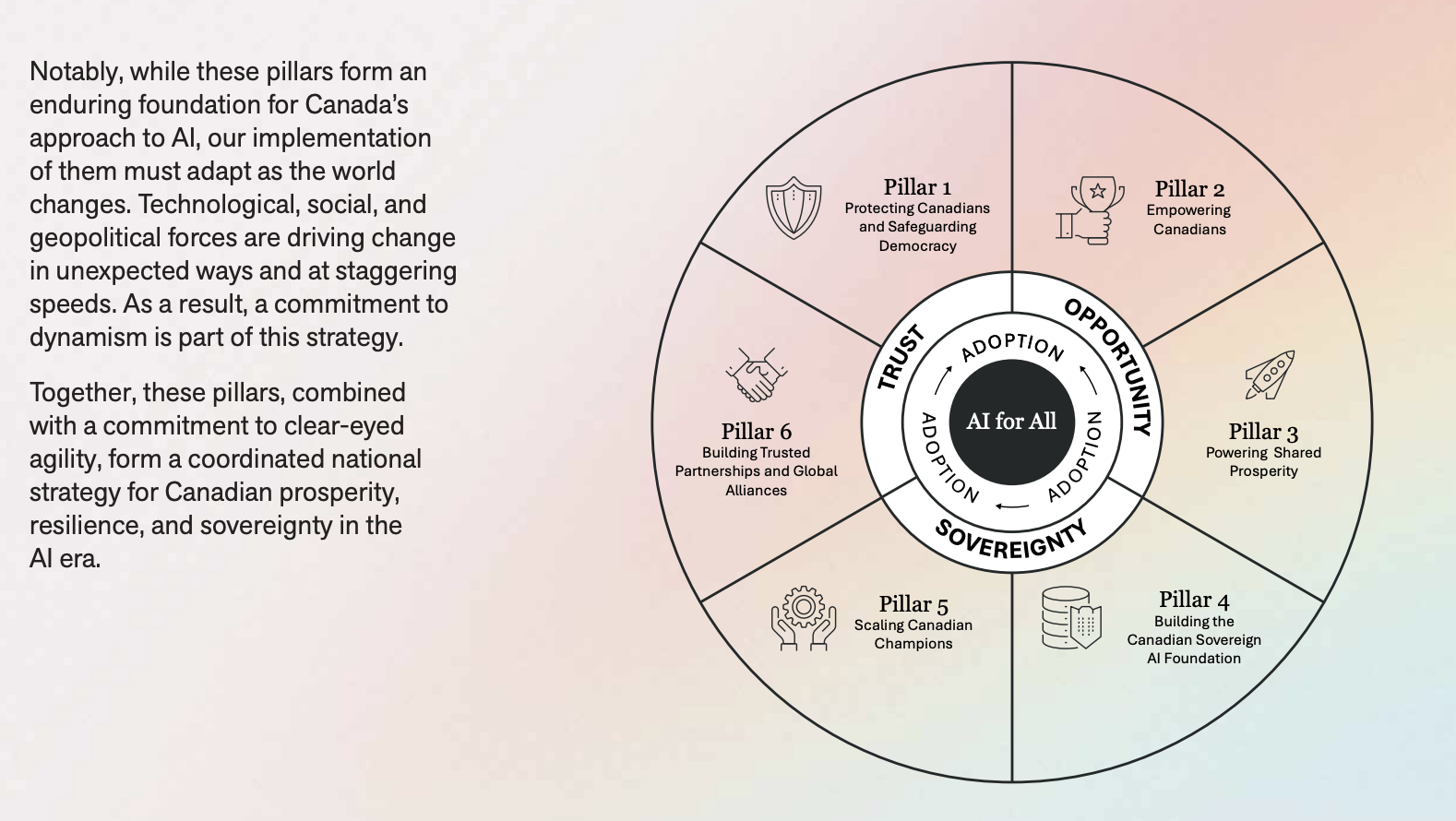
The strategy is built around three national ideas: trust, opportunity, and sovereignty. Those are not decorative words. They name the real sequence of adoption.
What I've observed in meaningful dialogue with thousands of people worldwide, I've come to the realization that people need to trust the AI systems. They need to see the opportunity. The country needs enough control over its infrastructure, talent, companies, and alliances to make its own choices.

This is where I think the mandate is correct. It does not begin with tools. It begins with trust.
That is the right order.
AI adoption does not fail because people are lazy, resistant, or incapable. It fails when people are asked to participate in something they do not understand, did not help shape, and do not trust enough to question.
A national AI strategy has to begin there, and so does an organizational one.
Trust is not a policy word
Trust sounds simple until leaders have to build it.
In the strategy, trust is treated as a national requirement. Canadians need to believe AI can be used safely, fairly, and responsibly. That includes privacy, safety, rights, public systems, and democratic resilience.
Inside organizations, the same principle applies at a different level.
Trust requires leaders to answer questions that cannot be sent to a technical team:
- What is AI being used for here?
- What will remain a human decision?
- Who is accountable when a tool influences an outcome?
- Where can employees raise concerns without being treated as blockers?
- How will people participate before decisions are already made?
Those are not software questions. They are leadership questions.
This is why I keep returning to the idea of being safe and brave. Safe comes first because people need enough clarity to speak honestly. Brave follows because honest participation still requires movement, judgment, and responsibility.
Canada cannot become an AI adoption nation if Canadians feel like AI is being done to them.
If you think about it, the six pillars are really six leadership conditions
The strategy names six pillars:
- Protecting Canadians and safeguarding our democracy
- Empowering Canadians
- Powering shared prosperity
- Building the Canadian sovereign AI foundation
- Scaling Canadian champions
- Building trusted partnerships and global alliances
That list can sound like policy architecture. I read it VERY differently.
I read it as a leadership map.
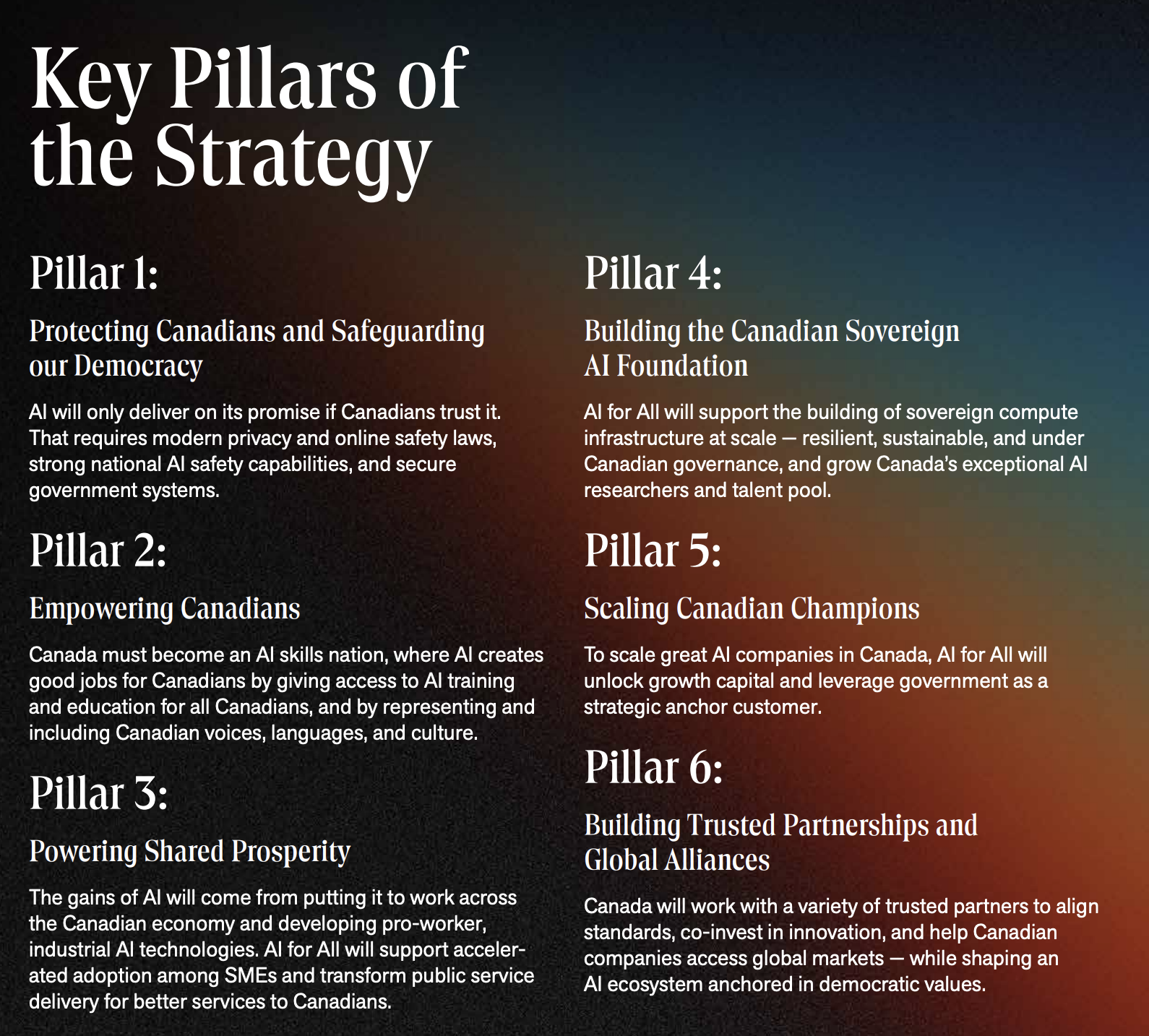
That's why I nerded out, went to my local printer and had it bound and spiraled to carry with me and share wherever I go...
For starters, Protection sets the boundary. Empowerment builds the human capacity. Prosperity connects adoption to real economic participation. Sovereign foundations protect national agency. Canadian champions carry capability into markets. Trusted partnerships prevent Canada from acting alone in a global system.
The order matters less than the relationship between them.
If protection becomes fear, adoption slows. If empowerment becomes training without participation, confidence stays thin. If prosperity becomes pressure on businesses to buy tools, the adoption gap stays open. If champions grow without trust, the country gains companies but loses public confidence.
The pillars only work together when leaders hold the whole system.
I'm quadrupling down on Pillar 2!
If I had to choose the most important pillar for the work I do, it would be Pillar 2: Empowering Canadians.
This is the human centre of the strategy.
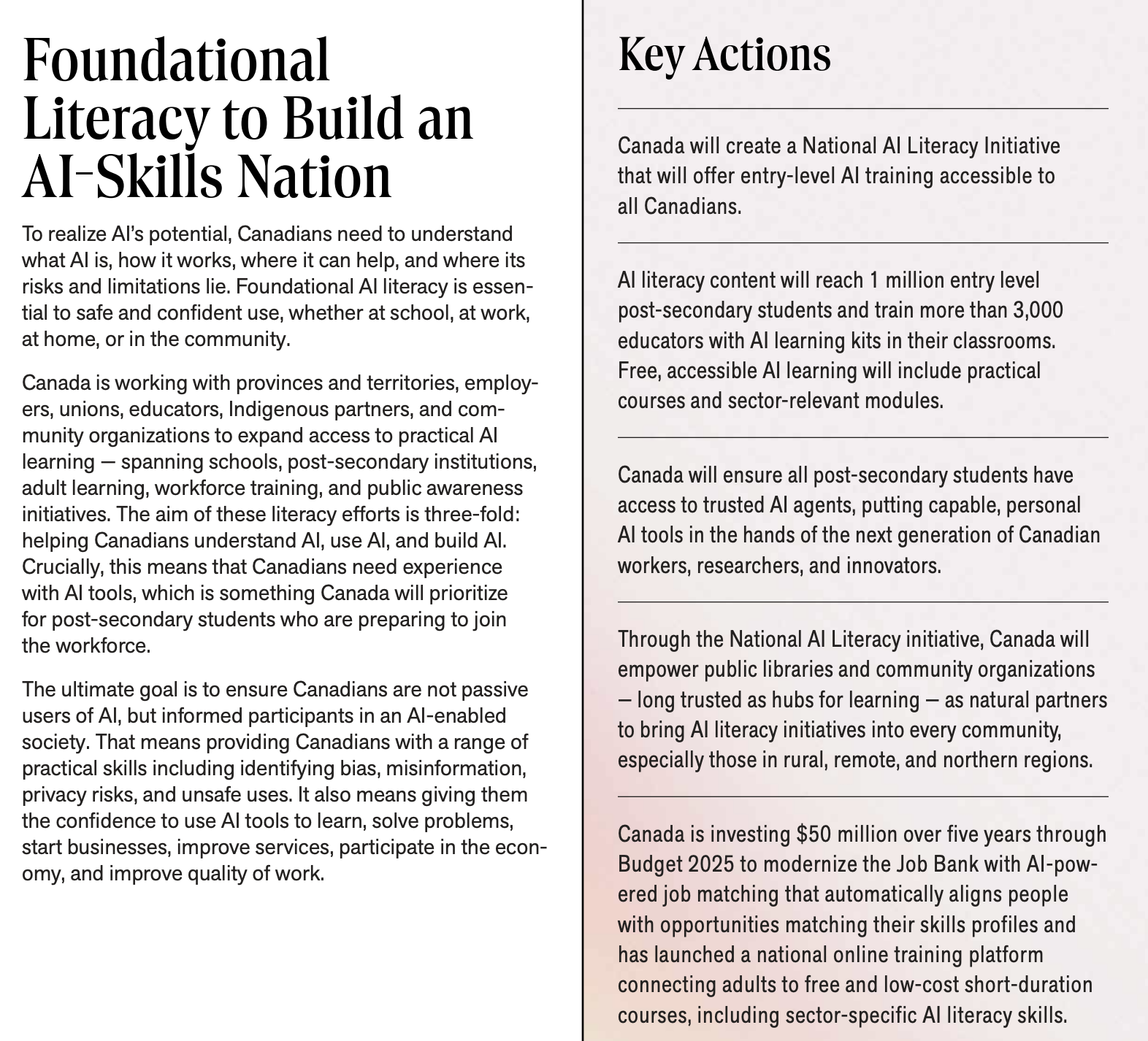
The report frames empowerment through literacy, opportunity, and participation. That is the right frame because AI literacy is not just knowing what a prompt is. It is knowing where AI belongs in your work, where it does not, and how to judge its output without surrendering your own responsibility.

This may be the most important image in the entire document.
It names three relationships Canadians can have with AI:
- Understanding AI
- Using AI
- Building AI
Each relationship produces something the country needs.
Understanding AI produces Canadians who can engage with confidence and safety. Using AI produces workers and businesses that can participate in AI-enabled work. Building AI produces breakthroughs and competitive firms.
That is the national opportunity.
It is also the national risk. If Canadians only understand AI through fear, hype, headlines, or vendor language, the relationship starts in the wrong place. If workers are asked to use AI before they understand how it affects judgment, trust breaks down. If builders create systems without public confidence, technical strength will not become shared prosperity.
This is where I see my role clearly.
As Vaseem The AI Guy, my work is to help people build a healthier relationship with AI. I don't push tools. I help leaders and teams understand what they are actually deciding, where their fear is coming from, and how to move from hesitation to responsible participation.
That is not separate from Canada’s strategy. It sits directly inside it.
AI literacy has to become workplace confidence
The strategy’s literacy ambition is significant.
Canada wants free AI training to be accessible to all Canadians. It also points to public libraries, community organizations, post-secondary institutions, educators, and workforce pathways as part of the learning infrastructure.
That matters because AI confidence cannot be reserved for executives, technical teams, or early adopters.
The real test will be whether literacy becomes practical.
People do not need abstract awareness alone. They need guided practice tied to the actual decisions they face:
- A worker deciding when to trust an AI-generated summary
- A manager deciding how to explain AI use to a team
- A small business owner deciding which use case is worth time and money
- A student deciding how to use AI without weakening their own thinking
- A community leader deciding how to include people who feel left behind
This is where training often fails. It teaches the tool before it names the tension.
Workers are not only asking, “How do I use this?” They are also asking, “What happens to my value, my role, my judgment, and my future?”
Leaders have to make room for those questions. Questions are expected here. A serious AI skills nation does not avoid discomfort. It structures the conversation so people can move through it.
The adoption gap is a translation problem
Canada’s business adoption target is ambitious. The strategy points to raising business AI adoption from about 12 percent today to 60 percent by 2034.
That number matters, but the gap behind it matters more.
Many small and medium-sized businesses are not waiting because they lack ambition. They are waiting because the value is still not clear enough. They hear about AI in broad terms, but they do not see the path from their daily work to a responsible use case.

This is not just an adoption gap. It is a translation gap.
Canadian businesses need practical, sector-specific pathways. They need to see where AI improves real work, where it introduces risk, and where human judgment must remain visible. They need financing, yes. They also need confidence.
That is why an AI readiness assessment matters.
Before a business chooses tools, it needs to know where it stands:
- Is leadership aligned on purpose?
- Do employees understand the intended use?
- Is there a safe way to test and learn?
- Are decision rights clear?
- Is the organization ready for the cultural impact of the change?
Without that clarity, funding can move faster than readiness. That is where avoidable friction begins.
Pillar 5 matters because Canadian agency matters
Pillar 5, Scaling Canadian Champions, deserves more attention than it will probably get.
The reason is simple. If Canadian AI companies grow somewhere else, Canada loses more than economic value. It loses influence over how AI is shaped, governed, and trusted.
Champions are not just companies. They are vehicles of national agency.
Canada has the research history. Geoffrey Hinton, Yoshua Bengio, and Richard Sutton are part of the modern AI story. The country has institutions, talent, and credibility. The question is whether that strength becomes durable Canadian capacity or whether it continues to flow outward.
This is where I see the Canadian AI champion role clearly.
I want Canadian companies to win. I also want them to win in a way that strengthens trust, builds internal capability, and helps leaders understand adoption as a people and culture challenge. Growth without trust is fragile. Technical excellence without human confidence leaves value on the table.
The companies that will matter most are not the ones that shout the loudest about AI. They are the ones that help organizations use it responsibly, explain it clearly, and build confidence inside the people who have to live with the decision.
The priority sectors need more than AI enthusiasm
The strategy names priority sectors where Canada has scientific, economic, and industrial strength:
- Health and life sciences
- Energy and natural resources
- Transportation
- Agriculture
- Manufacturing and robotics
These sectors make sense.
They are also sectors where adoption cannot be generic. The stakes, workflows, cultures, and trust conditions are different in each one.
A hospital does not adopt AI the way a manufacturer does. A natural resources company does not face the same workforce realities as a post-secondary institution. A transportation leader has different safety, data, and accountability questions than a small professional services firm.
This is why sector-specific dialogue matters.
The next phase of Canadian AI adoption cannot be built on broad awareness alone. It needs rooms where leaders, workers, technical experts, people leaders, and community voices can work through the practical questions together.
That is facilitation, not tool training.
The strategy is right to be dynamic
The conclusion of the strategy matters because it admits that AI is moving faster than any plan can fully anticipate.
That is a mature admission.
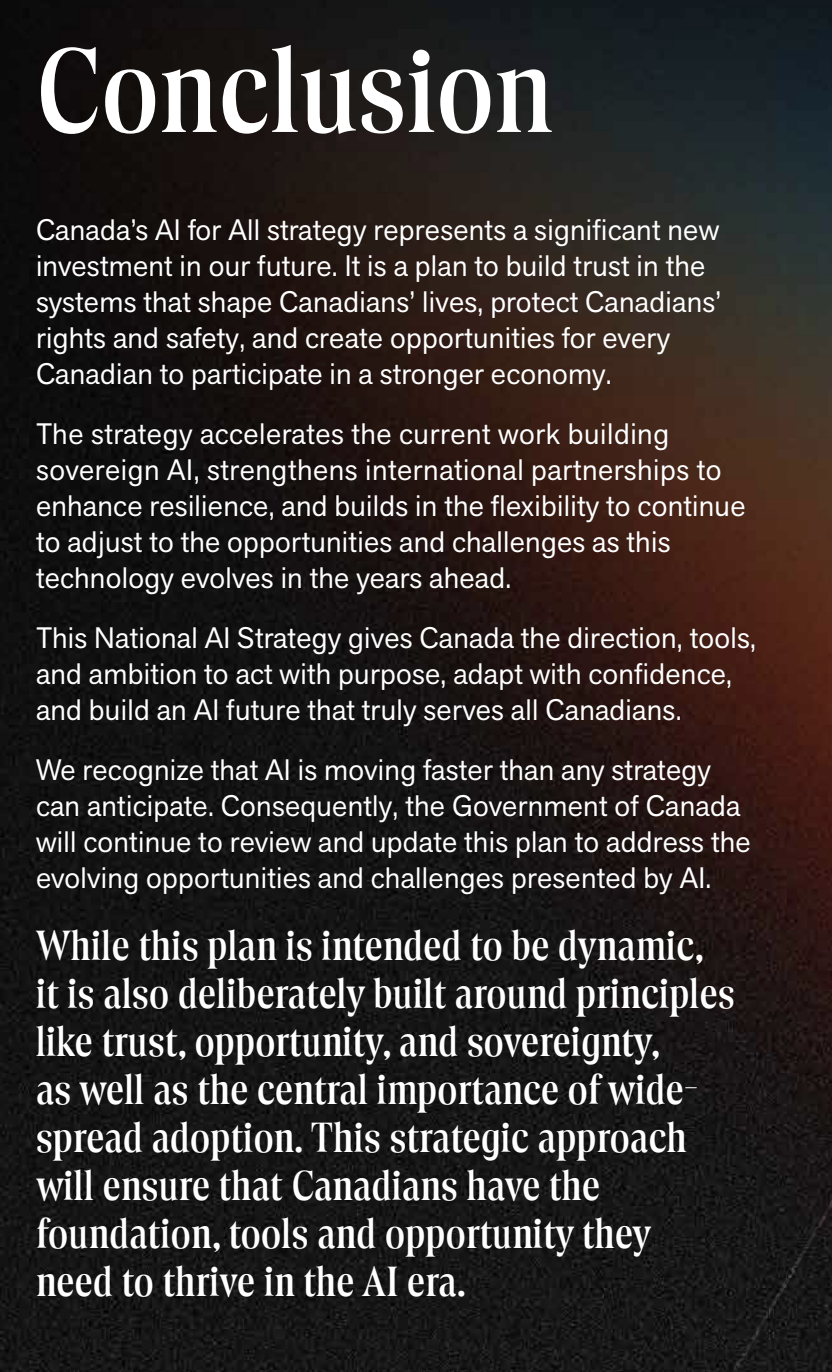
No national AI strategy will stay perfect for long. The point is not to predict every use case, risk, or market shift. The point is to create a responsible posture that can keep adapting without losing its centre.
For Canada, that centre appears to be trust, opportunity, sovereignty, and adoption.
For leaders, the same principle applies. The goal is not to have every AI answer before moving. The goal is to build the conditions where the organization can keep learning without losing clarity, safety, or judgment.
You do not need all the answers to move responsibly.
You do need a structure that allows people to participate honestly while decisions are being made.
What AI for All means to me
AI for All means the country is finally naming the human side of AI adoption.
It means AI literacy is not a side project. It is national infrastructure. It means workers need confidence, students need judgment, businesses need practical pathways, and leaders need to stop treating adoption as something that happens after a tool arrives.
It also means my work has a clear place in the national conversation.
As the AI Guy, a Canadian AI champion, and an AI Sherpa, I see my role as helping people climb this mountain without losing their footing. That means building understanding before use, judgment before confidence, and trust before widespread adoption.
The strategy gives Canada direction. The work still happens in rooms.
It happens when leaders slow the conversation down enough for people to speak honestly. It happens when workers are invited into the adoption question before decisions feel final. It happens when Canadian companies build tools and practices that strengthen trust rather than asking people to accept it on faith.
AI for All will not be proven by the document itself.
It will be proven by whether Canadians feel equipped enough to participate, confident enough to use AI responsibly, and included enough to help shape what comes next.
That is the leadership test.
So... dear reader..... if you're a leader in Canada, Let’s talk.